
Choosing an amp clamp
- tiride62
-
 Topic Author
- Offline
- Junior Member
-

- Posts: 31
- Thank you received: 0
Thanks for any help.
Please Log in or Create an account to join the conversation.
- Tyler
-
- Offline
- Moderator
-

- Full time HACK since 2012
- Posts: 6129
- Thank you received: 1545
 Personally, I'd get a low amp probe first, and worry about the high amp probe later (or never). I've always used a low amp probe for relative compression on gasoline engines, and never had any problems. Diesel is another story, due to higher starter current draw.
This is a capture I took off a GM 3.6L, with an AESWave low amp probe .
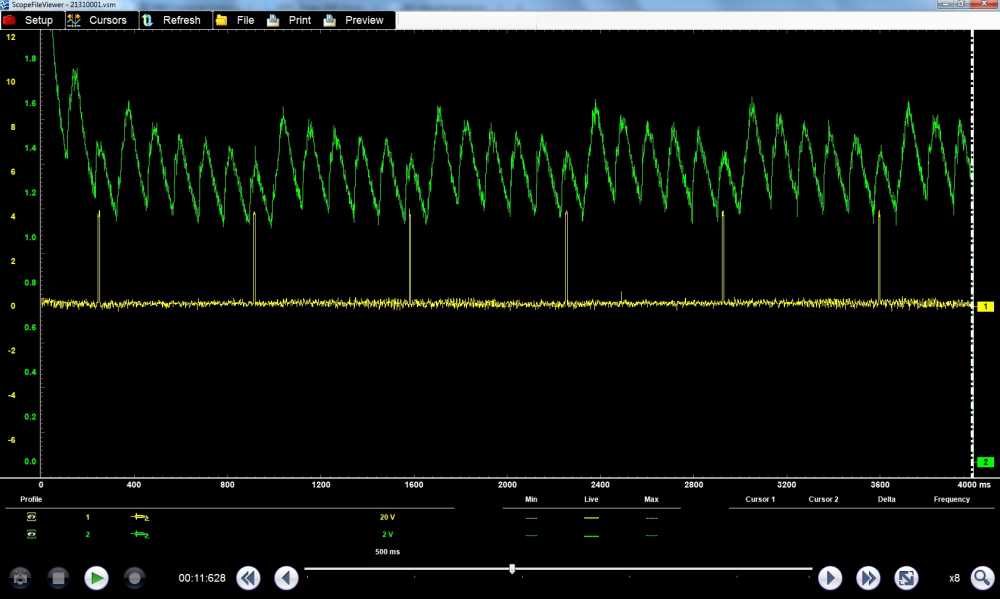
This was taken with a 2V scale on the compression trace, so no attenuator was required.

Please Log in or Create an account to join the conversation.
- tiride62
-
Topic Author
- Offline
- Junior Member
-
- Posts: 31
- Thank you received: 0
Thanks for the speedy reply. Could I ask what a compression trace is?Tyler wrote: Congratulations on getting your scope!
This is a capture I took off a GM 3.6L, with an AESWave low amp probe .
This was taken with a 2V scale on the compression trace, so no attenuator was required.
Please Log in or Create an account to join the conversation.
- Tyler
-
- Offline
- Moderator
-
- Full time HACK since 2012
- Posts: 6129
- Thank you received: 1545
Can you link me to the Hantek clamp you were looking at? The other consideration with low amp probes and relative compression testing is the inside diameter of the jaws. You want as wide as possible to fit around thick battery cables, or you won't get an accurate reading. The AESWave clamp measures out at just over 9mm.
Please Log in or Create an account to join the conversation.
- tiride62
-
Topic Author
- Offline
- Junior Member
-
- Posts: 31
- Thank you received: 0
www.hantek.com/en/ProductDetail_15_77.html
I'm in Canada so shipping is an issue from AESwave. I had to send my ScannerDanner book to my buddies in USA to make it more reasonable, Hantek I can get off Amazon.ca.
Please Log in or Create an account to join the conversation.
- Tyler
-
- Offline
- Moderator
-
- Full time HACK since 2012
- Posts: 6129
- Thank you received: 1545
tiride62 wrote: Hantek one is the same, 9mm. That was a concern as well. Here's a link to the Hantek website.
www.hantek.com/en/ProductDetail_15_77.html
I'm in Canada so shipping is an issue from AESwave. I had to send my ScannerDanner book to my buddies in USA to make it more reasonable, Hantek I can get off Amazon.ca.
Ahhhh right, what a pain.
 But that Hantek looks good to me! I say go for it, and let us know how you like it.
 Please Log in or Create an account to join the conversation.
- tiride62
-
Topic Author
- Offline
- Junior Member
-
- Posts: 31
- Thank you received: 0
Please Log in or Create an account to join the conversation.
- Ro-longo
-

- Offline
- Elite Member
-

- North Salt Lake, Utah
- Posts: 168
- Thank you received: 43
Tyler wrote: Congratulations on getting your scope!
I've used my Snap-On low amp clamp a few times on Diesels with no problems.
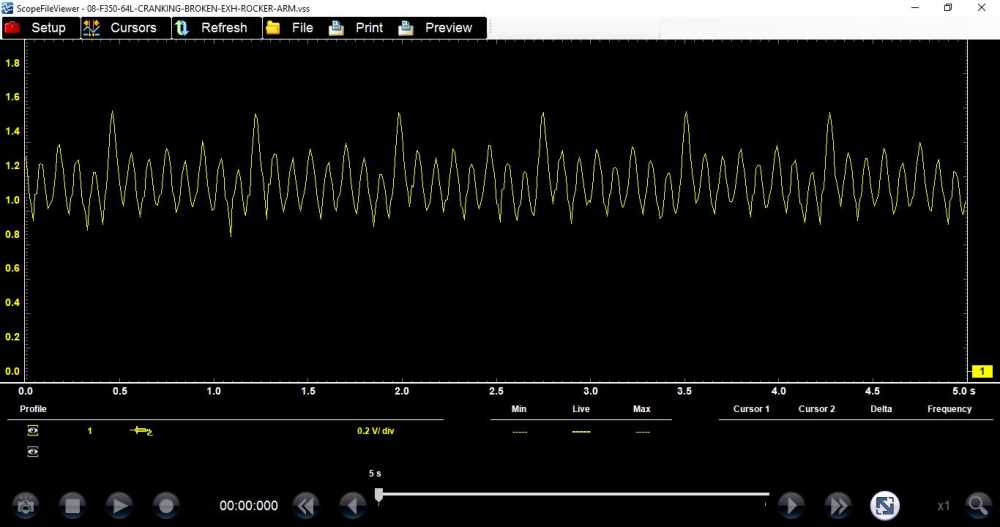
The above was taken off a Ford 6.4L with a broken exhaust rocker arm. This is how I test compression on all the Diesels I work on, I don't even own a Diesel compression tester. Just use the relative compression test.
"Silver bullets are for killing Werewolves, not fixing Cars." -Rob Longoria-
Please Log in or Create an account to join the conversation.
- Andy.MacFadyen
-

- Offline
- Moderator
-
- Posts: 3357
- Thank you received: 1037
" We're trying to plug a hole in the universe, what are you doing ?. "
(Walter Bishop Fringe TV show)
Please Log in or Create an account to join the conversation.
- tiride62
-
Topic Author
- Offline
- Junior Member
-
- Posts: 31
- Thank you received: 0
Any suggestions then?Andy.MacFadyen wrote: Avoid Hantek curent clamps if you can the quaily is pretty poor I have both high and low curent versions. The low current has an eye that is too small to fit over most alternator cables and the high curent clamp was delivered with a faulty switch. The tactile feel of the switches is poor and on both tools the the LED to show the unit is switched is so dim it can hardly be seen which can easily result in finding the battery dead next time you go to use it.
Please Log in or Create an account to join the conversation.
- Andy.MacFadyen
-
- Offline
- Moderator
-
- Posts: 3357
- Thank you received: 1037
Watiride62 wrote: Any suggestions then?
In North America I would probably look at what AESwave have to offer via the link on this site.
Very similar DC Amp clamps are sold under the Sealey brand in Europe I am going to order a Sealey TA311 in the near future to replace my high range Hantek.
I don't actually use the high range clamp much usually I do cranking voltage compression tests rather than current tests and I check alternator current with a Uni-T UT203 clamp multimeter. The low range amp clamp on the other hand is a very much used tool.
" We're trying to plug a hole in the universe, what are you doing ?. "
(Walter Bishop Fringe TV show)
Please Log in or Create an account to join the conversation.
- tiride62
-
Topic Author
- Offline
- Junior Member
-
- Posts: 31
- Thank you received: 0
I'll take a look. Not the right spot to ask but maybe you can direct me to a video or post that explains the difference between voltage compression test and current compression test?Andy.MacFadyen wrote:
Watiride62 wrote: Any suggestions then?
In North America I would probably look at what AESwave have to offer via the link on this site.
Very similar DC Amp clamps are sold under the Sealey brand in Europe I am going to order a Sealey TA311 in the near future to replace my high range Hantek.
I don't actually use the high range clamp much usually I do cranking voltage compression tests rather than current tests and I check alternator current with a Uni-T UT203 clamp multimeter. The low range amp clamp on the other hand is a very much used tool.
Please Log in or Create an account to join the conversation.
- Andy.MacFadyen
-
- Offline
- Moderator
-
- Posts: 3357
- Thank you received: 1037
So in voltage compression test a high voltage peak = a low compression cylinder.
" We're trying to plug a hole in the universe, what are you doing ?. "
(Walter Bishop Fringe TV show)
Please Log in or Create an account to join the conversation.
- tiride62
-
Topic Author
- Offline
- Junior Member
-
- Posts: 31
- Thank you received: 0
That was a simple, easily understandable explanation, you might have a future in teaching, LOL. Thanks again; GaryAndy.MacFadyen wrote: It is really simple put the scope across the battery + & - and crank the engine the peaks and troughs of the voltage trace are a inverted version of current trace.
So in voltage compression test a high voltage peak = a low compression cylinder.
Please Log in or Create an account to join the conversation.
- Tyler
-
- Offline
- Moderator
-
- Full time HACK since 2012
- Posts: 6129
- Thank you received: 1545
Ro-longo wrote: I've used my Snap-On low amp clamp a few times on Diesels with no problems.
Interesting. :huh: I've tried it on a Dodge 5.9L and 6.7L, ended up burying the probe, or chopping off the peaks of the waveform. Ended up falling back to a voltage compression waveform, like Andy mentioned.
Please Log in or Create an account to join the conversation.
- Ro-longo
-
- Offline
- Elite Member
-
- North Salt Lake, Utah
- Posts: 168
- Thank you received: 43
Tyler wrote:
Ro-longo wrote: I've used my Snap-On low amp clamp a few times on Diesels with no problems.
Interesting. :huh: I've tried it on a Dodge 5.9L and 6.7L, ended up burying the probe, or chopping off the peaks of the waveform. Ended up falling back to a voltage compression waveform, like Andy mentioned.
Now that you mention it, I don't think I have used it on a Dodge, I mainly work on Ford "Powerjokes"
"Silver bullets are for killing Werewolves, not fixing Cars." -Rob Longoria-
Please Log in or Create an account to join the conversation.
- Tyler
-
- Offline
- Moderator
-
- Full time HACK since 2012
- Posts: 6129
- Thank you received: 1545
Ro-longo wrote: Now that you mention it, I don't think I have used it on a Dodge, I mainly work on Ford "Powerjokes"
:lol: :lol: How have I never heard that before? Love it!
Please Log in or Create an account to join the conversation.
- tiride62
-
Topic Author
- Offline
- Junior Member
-
- Posts: 31
- Thank you received: 0
Please Log in or Create an account to join the conversation.
- Tyler
-
- Offline
- Moderator
-
- Full time HACK since 2012
- Posts: 6129
- Thank you received: 1545
tiride62 wrote: Ended up getting one from AESWave, an ES 695. Works fine with my DVOM but can't get a waveform to save my soul on my scope. It's most likely me but I've tried every possible combination of settings and nothing that looks even remotely like a current ramp. Scope is a Labnations Smartscope, it's not automotive friendly and I'm new to this so not a good combination. If I get a uscope any guidance on what accessory's I would want to be able to read waveforms for injectors and coils?
Hmmmmm, I'm not familiar with that scope, but I don't see why they wouldn't work together.
 Maybe try measuring a steady current first, like a headlight or similar, and make sure you're getting a rational reading. I borrowed this image from Google, but it's typical of measuring bulbs: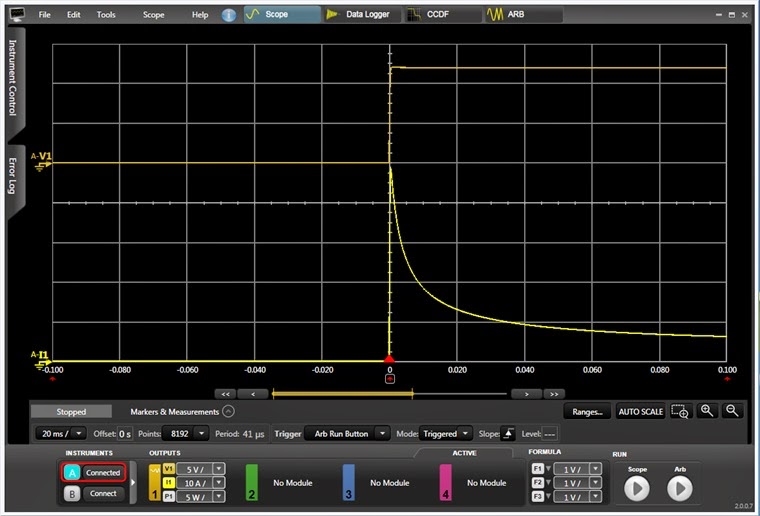
If you do go for a uScope, you'll likely need one of these adapters . The master kit comes with one, the basic does not.

Please Log in or Create an account to join the conversation.
- tiride62
-
Topic Author
- Offline
- Junior Member
-
- Posts: 31
- Thank you received: 0

Please Log in or Create an account to join the conversation.